Use braille while you still can
Braille is an endangered alphabet. Here's a guide to use it while it's still around.
Unified English Braille uses the same braille "cells" used represent the letters of several Europe-based languages (French, Spanish, Portuguese, German, etc).
A key difference is its use of contractions, combinations of braille letters or special characters that make reading and writing braille faster, and fit more content in less space (even contracted braille books are quite large). However, there are many contractions to remember, and they greatly increase the complexity of learning or describing braille in English.
It's used in Australia, Botswana, Canada, Fiji, Ghana, India, Ireland, Kiribati, Malaysia, Myanmar, Namibia, Nepal, New Zealand, Nigeria, Papua New Guinea, the Phillipines, Singapore, South Africa, South Korea, Tonga, the United Kingdom, the United States of America, Vanuatu, Vietnam and Zimbabwe.
Letters
Letter A to J
Braille’s first ten letters use only the top four dots.

a
b
c
d
e
f
g
h
i
j
Letters K to T
The second set of letters repeats the same dots as letters A to J, but adds the bottom left dot.

k
l
m
n
o
p
q
r
s
t
Letters U to Z
The end of the alphabet follows the same pattern again, with these characters adding both bottom bottom dots to the letters A to E.

u
v
x
y
z
Why is W out of place like this? Blame France; Braille was invented in French, which at the time hadn't adopted the letter. So while braille users still think of the alphabet as A to Z, learners must remember that W is the odd one out. However, once you learn this, all roman alphabet languages use the same pattern.
Letter W
The letter W resembles a J, but adds the bottom right dot, instead of both bottom dots (like it's end-of-of-the-alphabet neighbors). It's weird that way.

w
Numbers
Basic numbers and math are written by using the number symbol as a prefix. Texts with lots of math is usually done in a specialized braille code called Nemeth Braille.
The Number Sign signals that a number follows.

#
6,023
1 through 0 are letters in disguise. They use A through J, encoded as numbers 1 through 0. A number always follows the number sign (it gets confusing otherwise). Notice these on elevators.
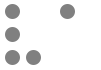
1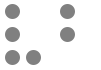
2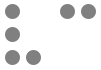
3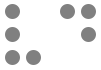
4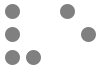
5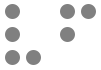
6
7
8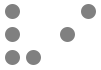
9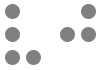
0
Formatting and Punctuation
Capital and italic letters are created using special characters along with the letters described above.
The capital sign signals that a number follows. Use it once for an initial cap, twice to capitalize the whole word. Three starts an uppercase passage, with two more ending it.

↑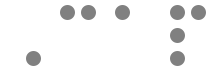
Cap
WORD
CAP IT ALL!
Italics use an italic symbol followed by a second character that indicates the length of italic style use.
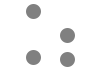
italic character
n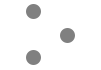
italic word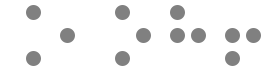
oh!
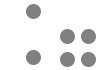
begin italic passage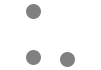
end italic passage
as if!
Punctuate sentences by following them with these characters.

.
,
!
?
:
;
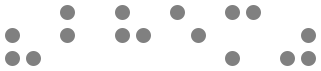
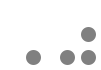
Quotes are opening and closing signs that enclose a word or words.

“
”
“ahem”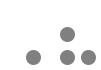
‘
’
‘true’
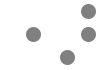
Parenthesis and Brackets are opening and closing signs that enclose a word or words.
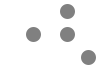
(
)
(aside)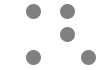
[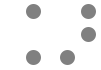
]
[edited]
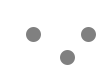
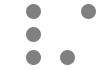
Hyphens, dashes, apostrophes, asterixes and ellipses can be placed anywhere. An apostrophe is a single dot 3, a hyphen both bottom dots. Make a with an apostrophe followed by a hyphen. An asterix is an apostrophe followed by a low i. An ellipsis, just like print, is three periods in a row.

-
–
‘
*
/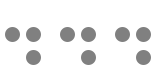
…
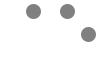
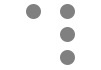
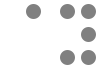
Currency symbols such as the dollar, British Pound, and yen are created with a currency sign (dot 4), followed by an s, e, l, or y. Hint: think of what the $, €, £, or ¥ symbols most resemble as the print letters S, E, L, and Y.

currency sign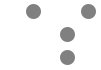
$
€
£
¥
Contractions
To fit more information on the page, English braille uses letters a through z as codes. Depending on the placement of the letter, it will expand to represent a different code. These changes are called contractions. It takes time to learn, but is able to reduce the number of characters down 300%.
A contractions
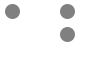 ababout
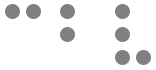 abvabove
 acaccording
 acracross
 afafter
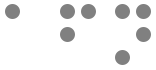 afnafternoon
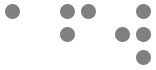 afwafterward
 agagain
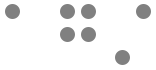 ag/against
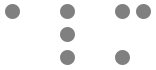 almalmost
 alralready
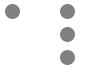 alalso
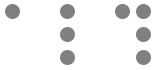 al?although
 altaltogether
 alwalways
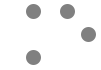 .e⌂ance
 &and
&and >ar
>ar zas
zas
B contractions
 2⌂bb⌂
2⌂bb⌂ 2be or be⌂
 2cbecause
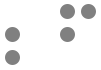 2fbefore
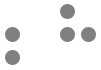 2hbehind
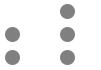 2lbelow
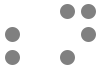 2nbeneath
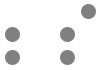 2sbeside
 2tbetween
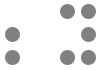 2ybeyond
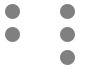 blblind
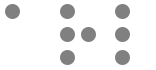 brlbraille
 bbut
bbut
C contractions
 ccan
ccan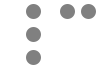 _ccannot
 3⌂cc⌂
3⌂cc⌂ *ch
*ch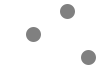 "*character
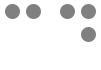 cdcould
 *child
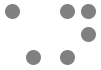 *nchildren
 3con⌂
3con⌂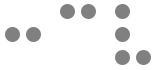 3cvconceive
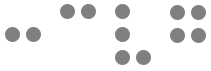 3cvgconceiving
C contractions
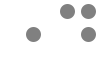 "dday
"dday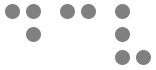 dcvdeceive
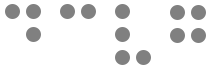 dcvgdeceiving
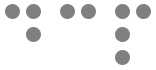 dcldeclare
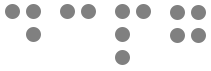 dclgdeclaring
 4dis⌂
4dis⌂ ddo
ddo
E contractions
 1⌂ea⌂
1⌂ea⌂ $ed
$ed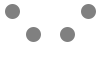 eieither
 5en
5en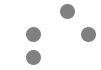 ;e⌂ence
 5enough
 ]er
]er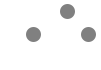 "eever
 eevery
F contractions
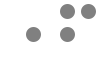 "ffather
 6⌂ff⌂
6⌂ff⌂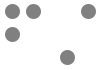 f/first
 =for
=for frfriend
 ffrom
ffrom ;l⌂ful
G contractions
 7⌂gg⌂
7⌂gg⌂ <gh
<gh ggo
ggo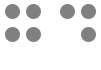 gdgood
 grtgreat
H contractions
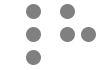 _hhad
_hhad hhave
hhave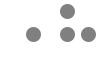 "hhere
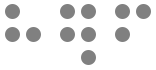 h]fherself
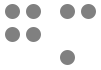 hmhim
hmhim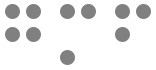 hmfhimself
 8his
8his
I contractions
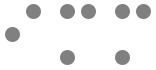 immimmediate
 9in
9in +ing
+ing xit
xit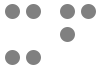 xsits
xsits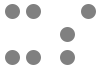 xfitself
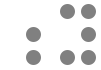 ;y⌂ity
J contractions
 jjust
jjust
K contractions
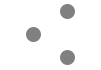 "kknow
 kknowledge
L contractions
 .s⌂less
 lrletter
 llike
llike lllittle
 "llord
M contractions
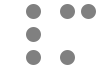 _mmany
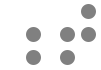 ;t⌂ment
 mmore
mmore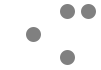 "mmother
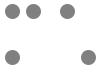 m*much
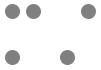 m/must
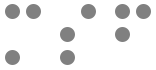 myfmyself
N contractions
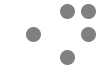 "nname
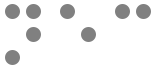 necnecessary
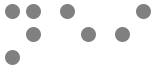 neineither
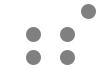 ;s⌂ness
 nnot
nnot
O contractions
 (of
(of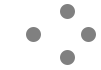 "oone
"oone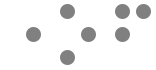 "ofoneself
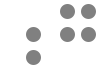 ;g⌂ong
 \ou
\ou "\ought
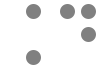 .d⌂ound
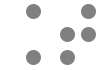 .t⌂ount
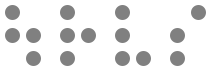 \rvsourselves
 \out
\out [ow
[ow
P contractions
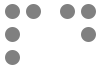 pdpaid
 "ppart
 ppeople
 p]cvperceive
 p]cvgperceiving
 p]hperhaps
Q contractions
 "qquestion
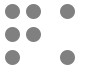 qkquick
 qquite
R contractions
 rrather
 rcvreceive
 rcvgreceiving
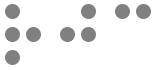 rjcrejoice
 rjcgrejoicing
 "rright
S contractions
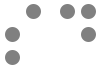 sdsaid
 %sh
%sh %shall
 %dshould
 .n⌂sion
 sso
sso "ssome
 _sspirit
 /st
/st /still
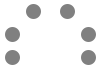 s*such
T contractions
 ?th
?th tthat
tthat !the
!the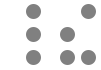 _!their
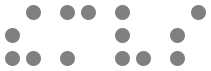 !mvsthemselves
 "!there
 ^!these
 ?this
?this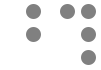 ^?those
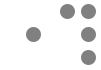 "?through
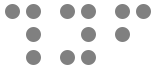 ?yfthyself
 "ttime
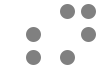 ;n⌂tion
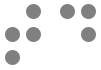 tdtoday
 tgrtogether
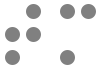 tmtomorrow
 tntonight
U contractions
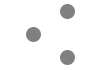 "uunder
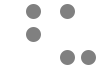 ^uupon
 uus
uus
V contractions
 vvery
vvery
W contractions
 0was
0was 7were
7were :wh
:wh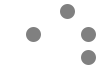 ":where
 :which
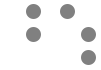 ^:whose
 wwill
wwill )with
)with ^wword
 "wwork
 _wworld
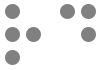 wdwould
Y contractions
 yyou
yyou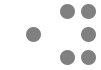 "yyoung
 yryour
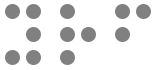 yrfyourself
 yrvsyourselves